
Construction Dewatering in Houston & the Gulf Coast
Groundwater control for excavations, utility trenches, pond work and foundations, from system selection to installation, monitoring and removal. One crew, and the same crew that can build the cofferdam or shoring the dry excavation sits inside.
Send us your plans · Call 832-803-6050
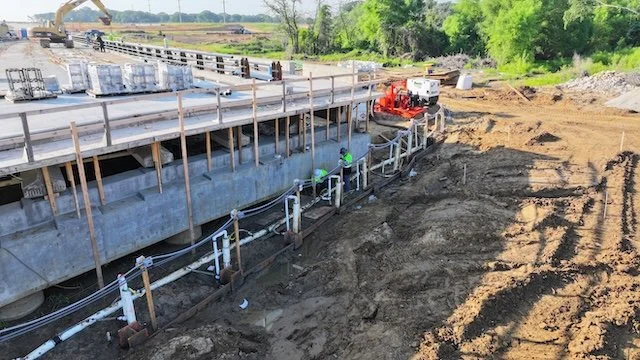
What we do
- Wellpoint systems. Closely spaced small-diameter wells on a header and vacuum pump. The workhorse for trenches and shallow-to-moderate excavations in sandy or silty ground.
- Deep well systems. Larger wells with submersible pumps, set outside the excavation. For deep cuts, high inflows and long-duration work where the water table has to come down a long way.
- Eductor systems. High-pressure water drives a vacuum at each well point, which suits low-permeability silts and layered clays where wellpoints struggle.
- Sump pumping. Open pumping from sumps inside the excavation. The simplest answer for surface water and modest inflows in stable ground.
- Bypass pumping. Temporary pumping around a section of sewer, storm line or channel so flow keeps moving while the work is done.
- Rim ditching. Perimeter ditches that intercept surface and near-surface water before it reaches the work, common on pond, detention and channel projects.
- Filtration & discharge. Settling and filtration before discharge, so the water leaving site meets the project's permit conditions.
- Contaminated water pump-out. Pump-out and containment of impacted water, hauled to approved permanent disposal facilities.
- Potable water delivery. Temporary potable water supply to site.
- Pump watch. Attended monitoring of running systems so a pump failure doesn't become a flooded excavation.
Choosing the right dewatering method
The method is set by the ground, the depth and the duration, not by what equipment is nearest the yard.
- Granular soils, shallow to moderate depth: wellpoints. Fast to install along a trench line; a single stage is limited by suction lift, so deeper cuts need a second stage or a different system.
- Deep excavations or high inflow: deep wells. Fewer, larger wells outside the footprint keep the work area clear and suit jobs that run for months.
- Silts, clayey sands and layered ground: eductors. They pull water from soils that drain too slowly for wellpoints and help relieve pore pressure at the base of the cut.
- Surface water and small inflows in stable ground: sump pumping, often alongside one of the above.
- Live flow in a pipe or channel: bypass pumping, sized to the peak flow the line actually carries.
Where the ground report leaves it open, we say so and design for the worse case rather than discovering it at the bottom of the excavation.
Dewatering on the Gulf Coast
Houston-area sites combine a shallow water table with stiff clays interlayered with silt and sand. The clay is rarely the problem; the sand seams inside it are, because they carry water into the excavation faster than the clay suggests.
Closer to the Ship Channel, Galveston Bay and tidal creeks, groundwater moves with the tide, and heavy rain can change inflows in an afternoon. From June to November, hurricane season decides how much standby pumping a job needs.
Discharge is part of the design, not an afterthought: water leaving site generally has to meet the project's stormwater permit conditions and local requirements, so settling and filtration are planned in from the start.
How a job runs
- Review. Drawings, geotech report, excavation depth and schedule. We flag gaps before pricing.
- Design & submittals. System layout, pump sizing, discharge plan and submittals for the engineer of record.
- Mobilize. Equipment, headers and wells installed ahead of excavation, not after water shows up.
- Operate & monitor. Drawdown checked against the design, pumps maintained, discharge monitored.
- Remove & close out. Wells abandoned or removed per requirements, site restored, records handed over.
For emergencies outside working hours, call 832-803-6050.
Frequently asked questions
How long does it take to set up a dewatering system?
It depends on the system and the site. A wellpoint line along a trench goes in quickly; a deep-well system needs drilling time. Either way it is installed ahead of excavation. Send the schedule and we will give you a set-up time with the price.
Do you design the system or just supply pumps?
Both. We select the method, lay out the system, size the pumps and plan the discharge, then install, run and remove it. Design and submittals are part of the service.
What information do you need to price a job?
The plans, the specifications (the project manual) and the geotechnical report.
Can you handle the discharge?
Yes. Settling and filtration are planned into the system so the discharge meets the project's permit conditions and local requirements.
Where do you work?
We serve the whole United States. Right now our crews are working in Texas, Louisiana, Mississippi, Alabama and Florida, from our base in Houston.
Send us your plans. Plans, specifications and geotech report to estimating@dynaconusa.com, or call 832-803-6050 (Mon–Fri, 7 AM–4 PM CST). We serve the whole United States, with current work in Texas, Louisiana, Mississippi, Alabama and Florida.