
Sheet Piling, Shoring & Cofferdam in Houston & the Gulf Coast
Cofferdams, sheet pile walls and trench shoring that keep excavations dry and stable, designed, submitted, installed and removed by one contractor. The same crew runs the dewatering inside the wall.
Send us your plans · Call 832-803-6050
What we do
- Cofferdams. Temporary and permanent cofferdams for work in or beside water: bridge piers, outfalls, intakes, pipeline crossings and structures below the water table.
- Sheet pile installation. Driven steel sheet pile for cofferdams, earth retention and cut-off walls.
- Cantilever shoring. Self-supporting sheet pile walls for moderate retained heights where bracing would get in the way of the work.
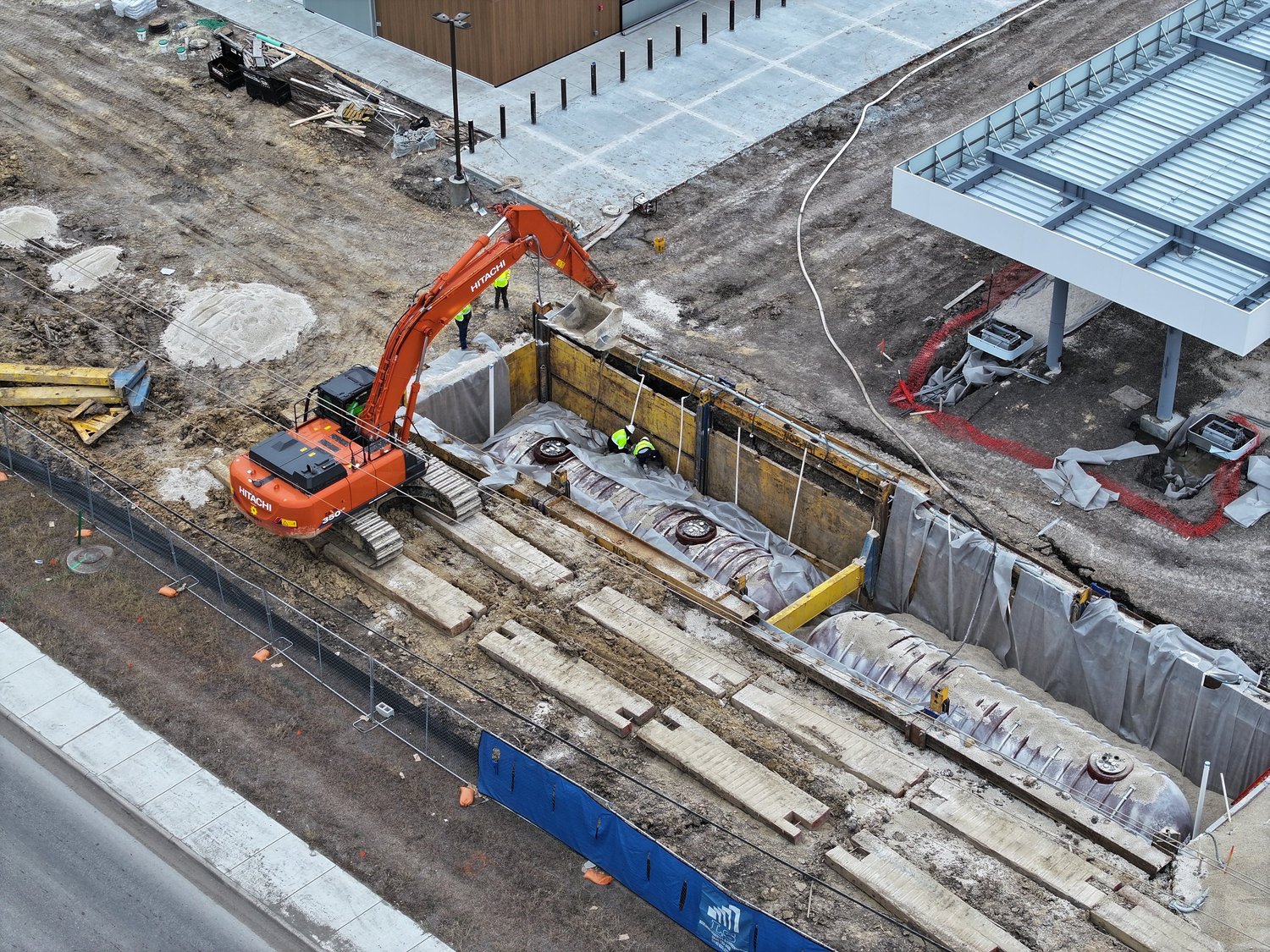
- Beam-and-plate shoring. Steel beams set at intervals with plates between them, for utility trenches and crossings where a trench box won't fit or can't be used.
- Aqua barriers. Water-filled temporary barriers, an alternative to sheet pile where a fast, low-impact way to hold back water suits the site.
- Engineering, design & submittals. Shoring design, calculations and submittals prepared for the engineer of record and the GC's schedule.
Choosing a shoring system
The right system depends on depth, water, the soil behind the wall, and what is next to the excavation.
- Working in or below water: a sheet pile cofferdam, braced or tied back as the depth requires, with dewatering inside it, or an aqua barrier where a water-filled barrier suits the site.
- Moderate depth, open work area needed: cantilever sheet pile, so there are no struts crossing the excavation.
- Deeper cuts or heavy surcharge: braced or anchored walls, with walers and struts designed for the load.
- Utility trenches and crossings: beam-and-plate or trench boxes, chosen for the trench width, depth and what is buried nearby.
- Next to structures, roads or live utilities: the wall is designed for deflection as well as strength, and installation method matters as much as section size.
Shoring on the Gulf Coast
Gulf Coast ground is soft and wet at depth. High groundwater adds water pressure to the soil load, and sand seams can wash out behind a wall that is not cut off properly. That is why the wall and the dewatering are best designed together.
Near the coast and tidal waterways, water levels move daily and with storms, so cofferdam height and bracing are set for the conditions the job will actually see.
OSHA requires protective systems for excavations 5 feet deep or more, and systems for excavations deeper than 20 feet must be designed by a registered professional engineer. Our submittals are built for that review.
How a job runs
- Review. Drawings, geotech, depths, adjacent structures and utilities, water levels.
- Design & submittals. Wall type, sections, bracing and calculations, submitted for approval.
- Install. Sheet pile driven, bracing set, and dewatering installed where needed.
- Monitor. Wall movement and water levels checked while the work inside proceeds.
- Remove & close out. Sheets extracted or left as specified, site restored.
Frequently asked questions
Do you provide the shoring design?
Yes. We prepare the shoring design, calculations and submittals, and coordinate with the engineer of record. Where the design must be sealed by a registered professional engineer, it is.
Can you build the cofferdam and dewater it?
Yes. That is the point of having both under one roof: the wall and the pumping are designed together, so there is one plan and one crew accountable for a dry excavation.
What do you need to price a cofferdam or shoring job?
The plans, the specifications (the project manual) and the geotechnical report.
Do you install trench shoring for utility work?
Yes. Beam-and-plate and sheet pile shoring for utility trenches and crossings, sized to the trench and what is around it.
Where do you work?
We serve the whole United States. Right now our crews are working in Texas, Louisiana, Mississippi, Alabama and Florida, from our base in Houston.
Send us your plans. Plans, specifications and geotech report to estimating@dynaconusa.com, or call 832-803-6050 (Mon–Fri, 7 AM–4 PM CST). We serve the whole United States, with current work in Texas, Louisiana, Mississippi, Alabama and Florida.